Midsummer Night’s Dream
INDIA v WEST INDIES at Lord's, London
(Prudential World Cup Final. June 25,1983)
This was perhaps the single greatest achievement in the annals of Indian cricket. And it was that element of surprise that made it even more special.
No one had given India a chance in the third edition of the World Cup in 1983. This was perfectly understandable considering their miserable record in the 1975 and 1979 events. A sole victory, that too against no-hopers East Africa in 1975 and a loss to Sri Lanka four years later, then still to attain full test status. This prompted one writer to suggest just before the 1983 World Cup, that India be demoted to the lower-grade ICC Trophy if it failed again. It’s another story that he was forced to eat his words - literally - a few weeks later, when India stunned the sporting world.
India had recorded their first Test victory on English soil in 1971 but it
was to be at Lord’s twelve years later, that Indian cricket would finally come
of age in the one-day game.
In fact, the seeds of one of the most remarkable upsets in sporting history were sown earlier that year. India beat the West Indies in a one-day international for the first time and that too, in the Windies’ own backyard. The victory by 27 runs at Berbice, Guyana was a vital psychological breakthrough-it convinced the Indians that the world champions were not invincible.
Less than three months later, India began their World Cup campaign in a league match against these reigning world champions at Old Trafford. West Indies had not lost a single match whilst steamrolling their way to victory in 1975 and 1979. Despite a last-wicket stand worth 71 runs, the unthinkable happened! Ravi Shastri had last man Joel Garner stumped for 37 and West Indies had lost its first match ever in a World Cup competition and that too to India!
That loss however, appeared as a mere blip on the Windies’ radar, as they continued to crush all else before them in the rest of their league games. This included a repeat match against India at the Oval, which the West Indies comfortably won by 66 runs.
India continued their surprising progress in the competition, but their campaign almost came to a premature end against lowly Zimbabwe at Turnbridge Wells. It took a breathtaking century by skipper Kapil Dev to save the day. An earlier defeat at the hands of Australia was duly avenged in their second match and, against all odds, India were actually in the semi-finals.
Even as the West Indies were routing Pakistan in their semi-final, a huge upset was being enacted at Old Trafford. England were the overwhelming favourites and were expected to gobble up India with ease. Instead, it was ‘Kapil Dev who eats three Bothams for Breakfast’ as one banner Put it so succinctly and his ‘Devils’ who swallowed the opposition. England’s batting collapsed in the face of a seemingly innocuous Indian pace attack and the Indian batting saw India coast home by 6 wickets.
This was just a precursor of things to come three days later at Lord’s.
Lord’s was a scalper’s paradise that incredible June day in 1983, as a packed house awaited what many forecasted would be a mismatch. The all-ticket final left many Indian supporters disappointed-how many of them after all would have had the foresight to buy tickets in advance? The day began cold and damp. But by the time skipper Clive Lloyd, in what he had hinted would be his farewell match, won the toss and sent India in, the weather was fine and the crowd full of Indians and West Indians were bubbling over with anticipation.
By the time India were all out for a measly 183 in 54.3 overs, Indian anticipation turned to despair even as Ladbrokes were offering odds at 100-1 on an Indian victory. Nothing, it appeared, could prevent a Caribbean hat-trick.
The Indian innings had been one of fits and starts. A poor beginning, a good recovery, a middle-order collapse and then some late-order resistance. The West Indian fast bowling attack was relentless in its pace and accuracy and the first instinct of the batsmen was one of survival.
Andy Roberts struck first thereby completing a miserable World Cup for Sunil Gavaskar as he was caught behind by Jeff Dujon for 2. Remarkably, it was to be Roberts’ first wicket in what was his third World Cup final. Then came the brightest part of the Indian innings. Amazingly, it would also be the only fifty plus stand in the match as flamboyant opener Krishnamachari Srikkanth, in his own inimitable style and the ever dependable Mohinder Amarnath, pieced together 57 invaluable runs for the second wicket.
Srikkanth’s innings was full of glorious hooks, cuts and drives, mixed with rustic strokes which only he could pull off. In contrast, Amarnath plodded on, pushing and nudging the ball around. Srikkanth’s 38-which wound up as the top score in the match-came from 57 balls and had seven 4s and a 6, while Amarnath’s innings consumed 81 deliveries with just three boundaries.
The shot of the day was without doubt a rasping drive from Srikkanth as he went down on one knee and creamed Roberts to the cover boundary. He also hooked the same bowler into the lower reaches of the Warner Stand for one of three 6s hit by an Indian batsman that day. Along the way, the dasher from Madras also played and missed at Malcolm Marshall the fastest bowler on display.
Srikkanth had produced all his tricks, including running a second run backwards, a strange if not unique sight for the Lord’s crowd. A recovery seemed underway, when he played across a straight ball from Marshall and was out lbw. India were 59 for 2 after 19 overs.
The run rate began to dip and the score was only 72 off 26 overs when change bowler Larry Gomes came on with his gentle off spinners.
In successive overs, Amarnath lashed Gomes through the covers, Yashpal Sharma pushed Holding for a boundary and then Amarnath moved down the track and hit Gomes for yet another 4. By the halfway mark - 30 overs - the Indian innings had progressed to 90 when AmarnSth was out with lunch fast approaching.
Off his short run, Holding still worked up enough pace to nip one back and send Amarnath’s off stump cartwheeling. it also brought the joy back into the ranks of West Indian supporters. The rock of the Indian batting had been dislodged-a crucial breakthrough.
Now began the collapse, ironically engineered by the innocuous Gomes whom the Indian batsmen perhaps underestimated as they sought to capitalise on his bowling.
In the penultimate over before lunch, Yashpal drove wildly only to give substitute Gus Logic (fielding for Haynes, who had bruised a hand) a swirling catch at deep cover. The score at the interval was 100 for 4 from 32 overs. Indian fans would not have much enjoyed their meal.
The Indian batsmen though, didn’t give up trying to make a meal of Gomes’ bowling after the break but their inexorable slide continued unabated. Kapil Dev, with his Turnbridge Wells carnage fresh in everyone’s memory, had taken a boundary off Vivian Richards’ sole over. He then heaved Gomes for two square-leg boundaries before holing out to Holding at long- on for 15 in an attempt to clear the ground. Indian hearts sank. Their hero and captain was gone and half the side was out for 1 1 0. Surely the beginning of the end?
In the next over, Kirti Azad was out for a duck, caught off a hook. Then Sandip Patil swung a 6 over mid wicket and Madan Lal smote Gomes for another. Gomes’ eleven overs had cost 49 runs but included two crucial wickets.
Once the fast bowlers came back, the Indian innings went into rapid decline. Patil messed up a pull off Garner and was caught at mid-on for 27 and Madan Lal had his bails trimmed as soon as Marshall returned. 7 wickets had tumbled for 71 runs in 15 overs and it seemed as if every one was in a hurry to complete the formalities and get home nice and early. Everyone, except for the last wicket pair of Syed Kirmani and Balwinder Singh Sandhu. They added 22 brave and vital runs. Sandhu was hit square on the helmet by Marshall but the number eleven remained calm. Between them the last pair raised the total steadily and by the time Holding bowled Kirmani for 14, the Indian score was 183.
it seemed atleast a hundred runs too short and the only logical question, how soon would it be before the Windies lifted the Cup for the third time?
Instead, it was the Indian bowlers who began to ask all the questions. And the West Indian batsmen were left short of answers. It was a curious case of killing them softly.
There was the early aberration of Gordon Greenidge shouldering arms, only to look back mortified as the gentle in-swinger from Sandhu clipped his bails-a moment that Sandhu would be asked to recall countless times in the years to come. Greenidge was out for 1 with the score on 5. But surely that was just a minor bump on the smooth Windies road to glory? Certainly Viv Richards, the King, Smokin’ Joe, Master Blaster, call him what you will was in a tearing hurry to get it all over with, pop the champagne corks and pick up his third winner’s medal in a row.
There was an air of disdain about Richards. He had plundered a century off the Indian bowling in the second league match and he was in no mood to tarry. For a brief while, he was once again the lord of Lord’s, the same venue where he had cracked a masterly century four years ago in the final against England.
Sandhu was pulled to mid-wicket for 4. Kapil Dev was driven through mid-off and mid-wicket for two more boundaries. Madan Lal’s military medium pace was smashed for three boundaries in his first over. It was a plunder the likes of which only the ‘Master Blaster’ was capable of pulling off. But it was too good to last.
In his second over, Madan Lal had Desmond Haynes caught by Roger Binny at extra cover for 13 off a careless drive after a stand worth 45-it would turn out to be the biggest of the West Indian innings.
Lloyd, who was unfit even before the toss but was determined to complete his golden hat-trick, came in and promptly pulled a muscle when he went for his first single. Haynes thus returned as his runner.
Now came perhaps the most dramatic moment in a day already so full of drama. Richards had smashed 33 runs from only 28 balls and his confidence-many would later say over- confidence-was sky-high. So was his pull, as he attempted to hoist Madan Lal out of the ground in the 14th over.
The ball, hit too high on the bat, soared towards the grandstand. "My heart was in my mouth even as 1 completed the stroke", Richards was to admit years later. So it was with the huge crowd and the entire Indian team, as Kapil Dev at mid-wicket sprinted in pursuit of what would be "the most important catch I’ve ever taken". The ball began its swirling descent, but the Indian captain kept his eyes on it and clasped it lovingly even as it appeared to be going over his shoulder.
Lloyd’s dismissal came when he lunged painfully forward to hit Binny only for Kapil to grasp another vital catch at mid- off. Later Kapil was to reminisce, "The first time 1 sensed we had a chance to win the game was when Clive Lloyd was dismissed." Though he went on to add, "But really, till the last wicket fell, 1 wasn’t thinking about anything other than just the game at hand".
With left-hander Gomes out just before Lloyd’s dismissal, having fished for a Madan Lal delivery outside off-stump only to edge to Gavaskar at slip, there was a roar of shock and delight all across the ground. The champions, against all odds were staggering at 66 for 5 and Madan Lal had picked up 3 wickets for next to nothing. It must have been a miserable tea break for all West Indians. The score read 76 for 5 after 25 overs.
It was the third ball after the break that saw Faoud Bacchus brilliantly caught by Kirmani off Sandhu without any addition to the score. 76 for 6.
Could the tailenders now undo the damage wrought by their illustrious batting colleagues? Dujon and Marshall tried. They put up some stiff resistance as runs trickled in and tensions rose to fever pitch. Only one boundary would come after the tea interval, a hook for 6 by Dujon. The cricket was now slow and attritional. Every run had to be squeezed out as the Indian attack suddenly sprouted fangs. Tight bowling, sharp fielding and the mounting pressure all played their part.
It was now that Amarnath was introduced into the attack. Lloyd’s instructions to his batsmen were to get after his bowling but it was ‘Jimmy’ who would have the last laugh. For it was the son of the great Lala Amarnath who would get after the batsmen to polish off the match.
The seventh wicket pair added 43 runs from 16 intense overs before Dujon was out. This was the 42nd over and with 65 still needed the wicket-keeper played forward to Amamath’s first delivery and then hurriedly tried to pull his bat away, but only succeeded in playing the gentle loosener onto his stumps. The look of anguish on the face of non-striker Marshall and the joyous surprise on the bowler’s face said it all.
Another innocent looking seamer from Amarnath moved just a fraction and Marshall edged to Gavaskar for 18. Kapil Dev returned for a final assault and had Roberts trapped in front. A sense of watching history unfold was now enveloping Lord’s even as the last pair of Joel Garner and Michael Holding held on for 7 agonising overs.
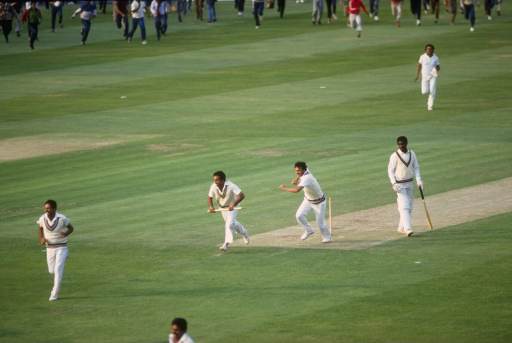
Amarnath came bobbing in again. Holding swung at the ball, missed, it hit his pads, umpire Dickie Bird’s finger went up and it was all over. India had won.
In the words of Kapil Dev, "Even after we had won, it took a long time to sink in that we had just won the World Cup. Slowly we realised the magnitude of that achievement. 1 don’t think I’ve felt more proud to be an Indian."
India had inherited the earth.
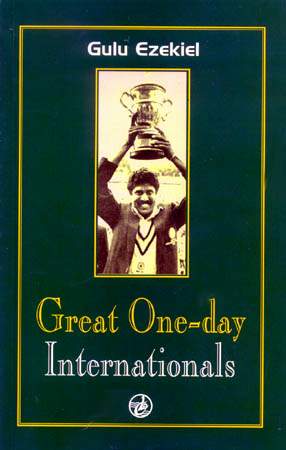
From Great One-Day Internationals by Gulu Ezekiel (1999, Orient Longman, New Delhi)
Also out by Gulu: The Story of World Cup Cricket 1999. Available from Konark Publishers, A-149 Main Vikas Marg, Delhi-92